
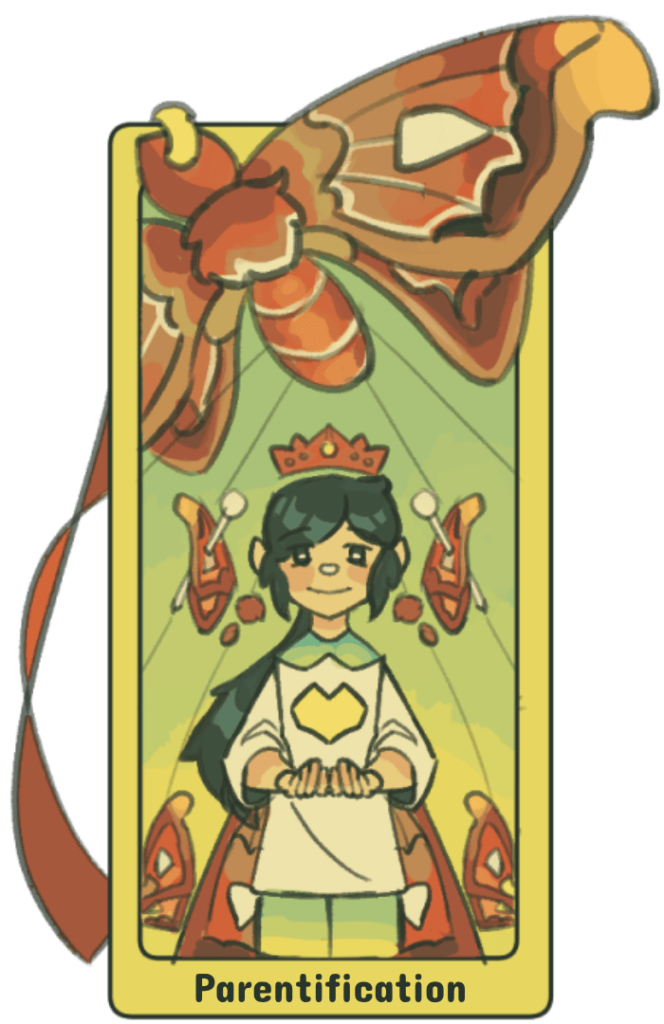

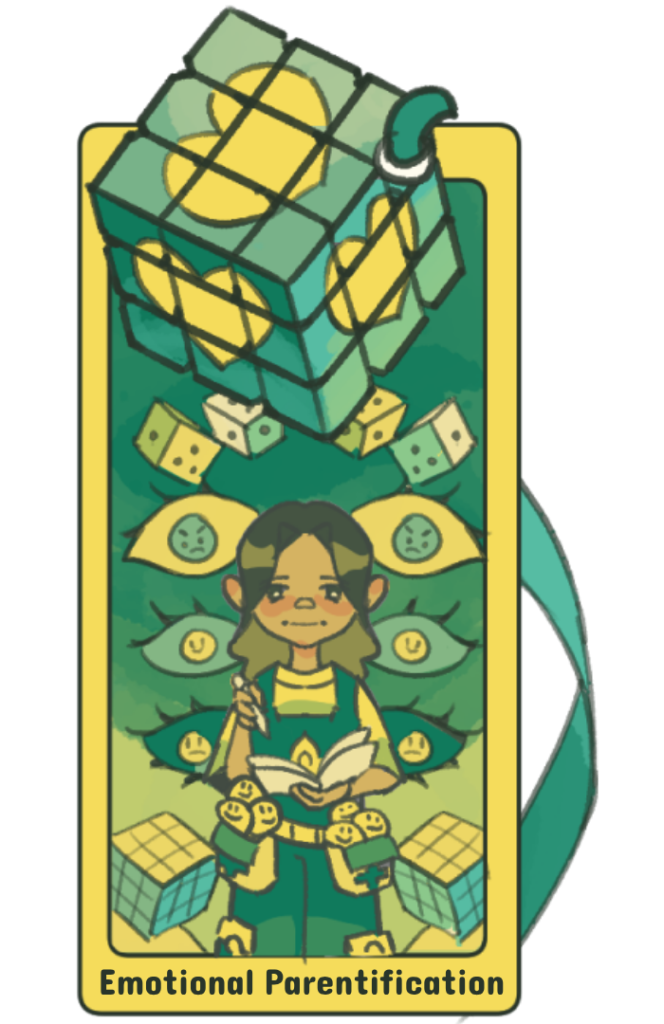
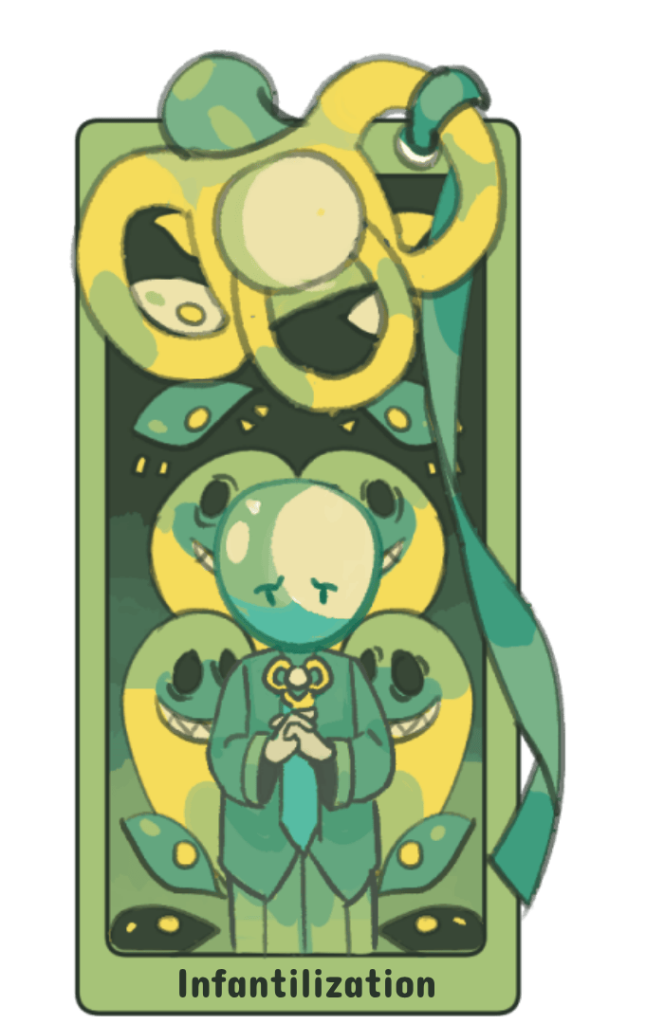
Well, look no further! Our team created an article that talks about the manifestations that inspired the children of the comic strips! Here we explain what these manifestations entail and how they may affect children as they grow older!
Remember: you are not a therapist or your guardians’ friends.
You are not responsible for their feelings or emotional turmoil.
That is not a burden that should have ever been put on you.
Trust in your abilities, despite what others say.
Take small steps to gain your independence and autonomy, and don’t ever be afraid to make mistakes.
Despite your guardians’ actions and words, always remember you are your own person.
At your own pace, find your own interests, learn to love and enjoy things that aren’t just your parents’ wishes.
No matter how big or small, what you want will always be valid.
You have done so well to help those around you.
Let yourself rest and rely on the people who love and care about you.
You don’t have to carry everything alone any longer.
Disclaimer: This video is for informational purposes only and is not to be used as a substitute for professional advice, diagnosis, or treatment. If you are experiencing emotional distress, please seek support from licensed professionals.
Community Resources: https://project-entangled-ph.com/iteration3/resources/
The following series was created as partial fulfillment of the video creators’ graduation project
Written by: Ange Flordeliza & Lauren Peralta
Voice Over & Audio Editing: Lauren Peralta
Illustration & Animation: Ange Flordeliza
Follow us on social media:
Facebook: Talihanan.ph
Instagram: talihanan.ph
Attributions List: https://project-entangled-ph.com/iteration3/about-us/
Credits for Music:
Bedroom Theme by Unicorn Heads
Allégro by Emmit Fenn
Sizzr by Schwartzy
The Girl from Saint-Anne-des-Plaines by The Mini Vandals
Disclaimer: This video is for informational purposes only and is not to be used as a substitute for professional advice, diagnosis, or treatment. If you are experiencing emotional distress, please seek support from licensed professionals.
The following series was created as partial fulfillment of the video creators’ graduation project
Written by: Ange Flordeliza & Lauren Peralta
Voice Over & Audio Editing: Lauren Peralta
Illustration & Animation: Ange Flordeliza
Video Editing: Ange Flordeliza
Follow us on social media:
Facebook: Talihanan.ph
Instagram: @talihanan.ph
Attributions List: https://project-entangled-ph.com/iteration3/about-us/
Credits for Music:
Bedroom Theme by Unicorn Heads
Sizzr by Schwartzy
The Girl from Saint-Anne-des-Plaines by The Mini Vandals
Flordeliza, M.A., Peralta J.L., Cabarrubia, S.M., Manzano, Puyat, M.J.(2024). Exploring Familial Enmeshment and its Impact on the Mental Well-being of Filipino Gen Z Adults in Metro Manila [Undergraduate Thesis], De La Salle-College of Saint Benilde].https://drive.google.com/file/d/1G0qBnNPVXaLuEHev8B4O8MSLZRjthSPE/view?usp=sharing
Burns, D. D., (2012). Feeling Good: The New Mood Therapy. United States: HarperCollins.
Chand SP, Kuckel DP, Huecker MR. Cognitive Behavior Therapy. [Updated 2023 May 23]. In: StatPearls [Internet]. Treasure Island (FL): StatPearls Publishing; 2026 Jan-. Available from: https://www.ncbi.nlm.nih.gov/books/NBK470241/
Deci, E. and Ryan, R., (1985) Self-Determination and Intrinsic Motivation in Human Behavior. Plenum Press: New York and London
Sarchuni, S. (2024). Efficacy of the Gottman Method on Family Cohesion and Emotional Self-Regulation Among Couples. Journal of
Assessment and Research in Applied Counseling, 6(3), 125-132. http://dx.doi.org/10.61838/kman.jarac.6.3.14
The Psychological Construction of Emotion. (2015). United Kingdom: Guilford Publications.
National Health Service. (2022). Cognitive behavioural therapy (CBT). Retrieved from https://www.nhs.uk/mental-health/talking-therapies-medicine-treatments/talking-therapies-and-counselling/cognitive-behavioural-therapy-cbt/
American Psychological Association Division 12. (2017). What is Cognitive Behavioral Therapy. https://www.apa.org/ptsd-guideline/patients-and-families/cognitive-behavioral
Barret L.F., Russell, J.A.(2014). The Psychological Construction of Emotion. Guilford publications.
Burns, D. D., (2012). Feeling Good: The New Mood Therapy. United States: HarperCollins.
Chernata, T. (2024). Personal boundaries: definition, role, and impact on mental health. Personality and Environmental Issues, 3(1), 24–30. https://doi.org/10.31652/2786-6033-2024-3(1)-24-30
Chand SP, Kuckel DP, Huecker MR. Cognitive Behavior Therapy. [Updated 2023 May 23]. In: StatPearls [Internet]. Treasure Island (FL): StatPearls Publishing; 2026 Jan-. Available from: https://www.ncbi.nlm.nih.gov/books/NBK470241/
Davis, J. L., Newman, E., & Pruiksma, K. E. (2009). Cognitive restructuring. In A. Rubin & D. W. Springer (Eds.), Treatment of traumatized adults and children: Clinician’s guide to evidence-based practice (pp. 103–177). John Wiley & Sons, Inc.
Damasio, A.(2004).Emotions and Feelings: A Neurobiological Perspective.DOI:10.1017/CBO9780511806582.004
Han, H.R., Miller, H. N., Manka Nkimbeng, Chakra Budhathoki, Mikhael, T., Rivers, E., Gray, J., Trimble, K., Chow, S., & Wilson, P. (2021). Trauma informed interventions: A systematic review. PLoS ONE, 16(6), e0252747–e0252747. https://doi.org/10.1371/journal.pone.0252747
The Psychological Construction of Emotion. (2015). United Kingdom: Guilford Publications.
Maree, J. G. (2021). The psychosocial development theory of Erik Erikson: Critical overview. Early Child Development and Care, 191(7-8), 1107–1121. https://doi.org/10.1080/03004430.2020.1845163
Sanchez, A. L., Comer, J. S., & LaRoche, M. (2022). Enhancing the responsiveness of family-based CBT through culturally informed case conceptualization and treatment planning. Cognitive and Behavioral Practice, 29(4), 750–770. https://doi.org/10.1016/j.cbpra.2021.04.003
Roman, N. V., Balogun, T. V., Butler-Kruger, L., Danga, S. D., Therese, J., Human-Hendricks, A., Fundiswa Thelma Khaile, October, K. R., & Olabiyi, O. J. (2025). Strengthening Family Bonds: A Systematic Review of Factors and Interventions That Enhance Family Cohesion. Social Sciences, 14(6), 371–371. https://doi.org/10.3390/socsci14060371
Flordeliza, M.A., Peralta J.L., Cabarrubia, S.M., Manzano, Puyat, M.J.(2024). Exploring Familial Enmeshment and its Impact on the Mental Well-being of Filipino Gen Z Adults in Metro Manila [Undergraduate Thesis], De La Salle-College of Saint Benilde].https://drive.google.com/file/d/1G0qBnNPVXaLuEHev8B4O8MSLZRjthSPE/view?usp=sharing
Sturge-Apple, M. L., Davies, P. T., & Cummings, E. M. (2010). Typologies of family functioning and children’s adjustment during the early school years. Child development, 81(4), 1320–1335. https://doi.org/10.1111/j.1467-8624.2010.01471.x
Cahill, K. M., Updegraff, K. A., Causadias, J. M., & Korous, K. M. (2021). Familism values and adjustment among Hispanic/Latino individuals: A systematic review and meta-analysis. Psychological Bulletin, 147(9), 947–985. https://doi.org/10.1037/bul0000336
Chua, C., Gabriel, F., Bantang, J., Llige, A.(2022). Conceptualization of Filipino family wellbeing. International Journal of Home Economics, 15(2), 103-114.https://www.ifhe.org/fileadmin/user_upload/e_Journal/Vol_15_2_corr/P11_1.pdf
Garber, B. D. (2021). The dynamic of the enmeshed family system ten years later: Family court and contemporary understanding of adultification, parentification, and infantilization. Journal of the American Academy of Matrimonial Lawyers, 34, 97-120.
Maree, J. G. (2021). The psychosocial development theory of Erik Erikson: Critical overview. Early Child Development and Care, 191(7-8), 1107–1121. https://doi.org/10.1080/03004430.2020.1845163
Monte, R. N., & Ligacion, C. J. (2025). Assessing generational shifts: A definitive study of the evolution of values, behaviors, and attitudes. International Journal of Psychology Sciences, 7(1), 135–140. https://doi.org/10.33545/26648377.2025.v7.i1b.89
Mori, G,. Alejandra, Y., Quijano, B., Salazar, A.B., Sanchez, A.(2023). Feminism through the lens of the Gen Z. American Journal of Youth and Women Empowerment, 2(1), 8-16. https://doi.org/10.54536/ajywe.v2i1.1796
Roman, N. V., Balogun, T. V., Butler-Kruger, L., Danga, S. D., Therese de Lange, J., Human-Hendricks, A., Thelma Khaile, F.,
October, K. R., & Olabiyi, O. J. (2025). Strengthening Family Bonds: A Systematic Review of Factors and Interventions That Enhance Family Cohesion. Social Sciences, 14(6), 371. https://doi.org/10.3390/socsci14060371
Stapley, E., Vainieri, I., Li, E., Merrick, H., Jeffery, M., Foreman, S., Casey, P., Ullman, R., & Cortina, M. (2021). A Scoping Review of the Factors That Influence Families’ Ability or Capacity to Provide Young People With Emotional Support Over the Transition to Adulthood. Frontiers in Psychology, 12. https://doi.org/10.3389/fpsyg.2021.732899
Swann, W. B., Jr., Jetten, J., Gómez, Á., Whitehouse, H., & Bastian, B. (2012). When group membership gets personal: A theory of identity fusion. Psychological Review, 119(3), 441–456. https://doi.org/10.1037/a0028589
Adebayo, Y. O., Adesiyan, R. E., Amadi, C. S., Ipede, O., Karakitie, L. O., & Adebayo, K. T. (2024). Cross-cultural perspectives on mental health: Understanding variations and promoting cultural competence. World Journal of Advanced Research and Reviews, 23(1), 432–439. https://doi.org/10.30574/wjarr.2024.23.1.2040
Bacon, I., & Conway, J. (2022). Co-dependency and Enmeshment — a Fusion of Concepts. International Journal of Mental Health and Addiction, 21(6). https://doi.org/10.1007/s11469-022-00810-4
Barber, B. K., & Buehler, C. (1996). Family Cohesion and Enmeshment: Different Constructs, Different Effects. Journal of Marriage and Family, 58(2), 433–433. https://doi.org/10.2307/353507
Calatrava, M., Martins, M. V., Schweer-Collins, M., Duch-Ceballos, C., & Rodríguez-González, M. (2022). Differentiation of self: A scoping review of Bowen Family Systems Theory’s core construct. Clinical psychology review, 91, 102101. https://doi.org/10.1016/j.cpr.2021.102101
Chernata, T. (2024). Personal boundaries: definition, role, and impact on mental health. Personality and Environmental Issues, 3(1), 24–30. https://doi.org/10.31652/2786-6033-2024-3(1)-24-30
D’Astice, T., Russell, W.P. (2019). Enmeshment in Couples and Families. In: Lebow, J.L., Chambers, A.L., Breunlin, D.C. (eds) Encyclopedia of Couple and Family Therapy. Springer, Cham. https://doi.org/10.1007/978-3-319-49425-8_1021
Garber, B. (2021). The Dynamics of Enmeshed Family System Ten Years Later: Family Court and Contemporary Understanding of Adultification, Parentification, and Infantilization. Journal of the American Academy of Matrimonial Lawyers. 34, 97-120. https://familylawconsulting.org/publications/Enmeshment%202021%20update.pdf
Hall, E.T. (1976). Beyond Culture. NY: Anchor Books.
Hann-Morrison, D. (2012). Maternal Enmeshment: The Chosen Child. SAGE Open, 2(4), 215824401247011. https://doi.org/10.1177/2158244012470115
Mary Moussa R., Cuccolo, K., McKinney, C., Edlund, J. E., Grahe, J. E., Zlokovich, M. S., Bauer, L. M., El-Kour, T., Tabea Hässler, Jia, F., Norvilitis, J., Shane-Simpson, C., R. Andrew Yockey, Cramblet, L. D., Eisner, L., Thomas Rhys Evans, Farahani, H., Haden, S., Hawkins, G., & Kawabata, Y. (2024). Understanding Family Dynamics in a Cross-Cultural Sample: A Multi-National Study. Psi Chi Journal of Psychological Research, 29(2), 140–149. https://doi.org/10.24839/2325-7342.jn29.2.140
Minuchin, S. (1974). Families and family therapy. Cambridge, MA: Harvard University Press.
Minuchin, S., & Fishman, H. C. (1981). Family therapy techniques. Cambridge, MA: Harvard University Press
Pe-Pua, R., & Protacio-Marcelino, E. (2000). Sikolohiyang Pilipino (Filipino psychology): A legacy of Virgilio G. Enriquez. Asian Journal of Social Psychology, 3(1), 49–71. https://doi.org/10.1111/1467-839X.00054
World Health Organization. (2023, October 12). DOH, WHO launch Philippine Council for Mental Health Strategic Framework 2024-2028. Who.int; World Health Organization: WHO. https://www.who.int/philippines/news/detail/12-10-2023-doh–who-launch-philippine-council-for-mental-health-strategic-framework-2024-2028
Vlaicu, C., & Haidu Felicia Aurica. (2020, May 25). CO-DEPENDENCY IN INTIMATE RELATIONSHIP-A LEARNED BEHAVIOUR. ResearchGate; unknown. https://www.researchgate.net/publication/342504976_CO-DEPENDENCY_IN_INTIMATE_RELATIONSHIP-A_LEARNED_BEHAVIOUR
Saret, D. M. (2023, October 30). [OPINION] Mental health and toxic Filipino culture. RAPPLER. https://www.rappler.com/voices/ispeak/opinion-mental-health-toxic-filipino-culture/
Arnaldo, S. (2023, January 31). “Utang na loob?” Filipino family values gone wrong, and how they affect mental health. RAPPLER. https://www.rappler.com/life-and-style/relationships/filipino-family-values-gone-wrong/