
ADVOCACY
SUPPLEMENTARY RESOURCES
Thoughts, Feelings, and Emotions: What's the Difference?
Written By: Mary Angeline Flordeliza

In Cognitive Behavioral Therapy (CBT), one’s thoughts, feelings, and emotions are treated as distinct constructs from each other and have the ability to influence the other (American Psychological Association Division 12, 2017).
To illustrate, the graph below breaks down the difference between these three.
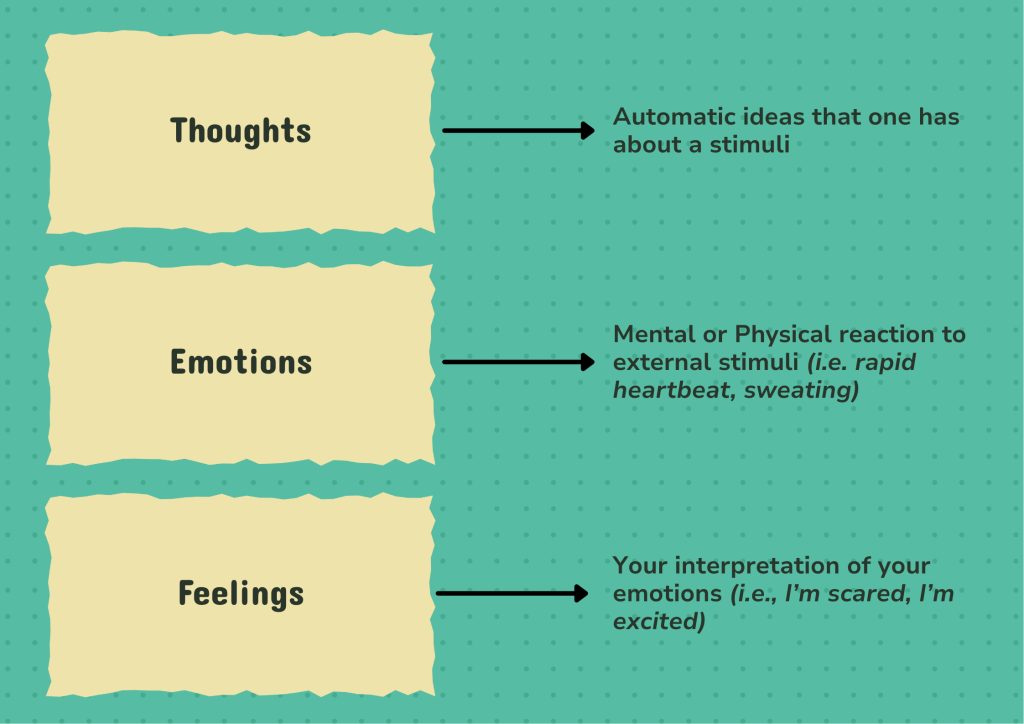
While these concepts are usually interchanged with one another, mixing them may result in cognitive distortions. Since our thoughts, feelings, and behaviors are connected –this may also easily create negative feedback loops if our thoughts are distorted (Chand et. al, 2023).
For example, having an automatic thought that says, “I feel like a failure, so I am a failure.”
- Here, defining oneself as a failure is not an emotion, but an automatic thought.
- While the guilt and shame in response to an event, is the emotion.
- However, once you interpret the emotion and event as something negative that defines your character, the interpretation is the feeling.
Reevaluating Thoughts and Feelings
These negative automatic thoughts when repeated can become a core belief about oneself. So, instead of immediately identifying oneself as a failure, it can help to name the emotion such as “ I am feeling really guilty and shameful right now”.
This allows you to not attack your own character, and focus on getting curious about where those thoughts come from. This technique is called –Reattribution, where we are taught to reevaluate our interpretations and how we assign blame (Burns, 2012). If you’d like to know more about cognitive distortions and how to combat them, the books “Feeling Good: The New Mood Therapy” or “Feeling Great: The Revolutionary New Treatment for Depression and Anxiety” by Psychiatrist David Burns, discusses these in more depth.
Our Logic is tied to our Emotions
However, if your emotions feel intense, it is helpful to pause, and focus on grounding yourself first such as breathing exercises, walking, or music (Although different folks have different strokes, so, feel free to do what works for you as these are just general examples).
According to Damasco (2004), our brain or limbic system processes emotions first, before we can think of a logical reason –this is called Emotional Primacy. We then try to explain those emotions using logic or the automatic thoughts that pop up (Schacter & Singer, 1962). However, automatic thoughts that are often negative and intrusive can be prone to cognitive distortion.
For example, during a state of experiencing intense negative emotions, you may find yourself stuck thinking about cognitive distortions. A few examples from David Burns’ Books include:
- Should statements – “I should be happy because I’m not suffering as much as others.”
- All or Nothing thinking – “I’m/They’re always breaking things.”
- Mind Reading – “They probably think I’m weak and incompetent.”
- Emotional Reasoning – “I feel like a failure, so I am a failure.”
Instead of challenging these intrusive thoughts, your brain may exaggerate the negative, minimize the positive, or cherry-pick what aligns with your current views –which then feeds into one’s distress even more– eventually distorting your perceptions about people, situations, and or reality.
So, What Can I Do?
Ideally and generally, it is still recommended for individuals to go to mental health providers. They can help people to identify and challenge cognitive distortions that may stem from distressing situations, trauma, or abuse. This will also help to mitigate or aid any psychological distress that may occur while thinking about potentially triggering topics, as well as reconnect with themselves or regulate when they feel unbalanced.
If you need help in finding mental health providers, our team has curated a list of community resources that you can find in the link below!
Note: These resources are based in the Philippines; check for mental healthcare providers in your region, as they may be more fit towards your needs.
REFERENCES AND READINGS
American Psychological Association Division 12. (2017). What is Cognitive Behavioral Therapy. https://www.apa.org/ptsd-guideline/patients-and-families/cognitive-behavioral
Burns, D. D., (2012). Feeling Good: The New Mood Therapy. United States: HarperCollins.
Chand, S. P., Kuckel, D. P., & Huecker, M. R. (2023, May 23). Cognitive Behavior Therapy. Nih.gov; StatPearls Publishing. https://www.ncbi.nlm.nih.gov/books/NBK470241/
Damasio, A. (1999). The Feeling of What Happens: Body and Emotion in the Making of Consciousness. Philpapers.org. https://philpapers.org/rec/DAMTFO
Damasio, Antonio. (2004). Emotions and Feelings: A Neurobiological Perspective. 10.1017/CBO9780511806582.004.
National Health Service. (2022). Cognitive behavioural therapy (CBT). Retrieved from https://www.nhs.uk/mental-health/talking-therapies-medicine-treatments/talking-therapies-and-counselling/cognitive-behavioural-therapy-cbt/
Schachter, S., & Singer, J. (1962). Cognitive, social, and physiological determinants of emotional state. Psychological Review, 69(5), 379–399. https://doi.org/10.1037/h0046234